Wednesday, July 13, 2011

Maria

 Maria
July 11, 2011
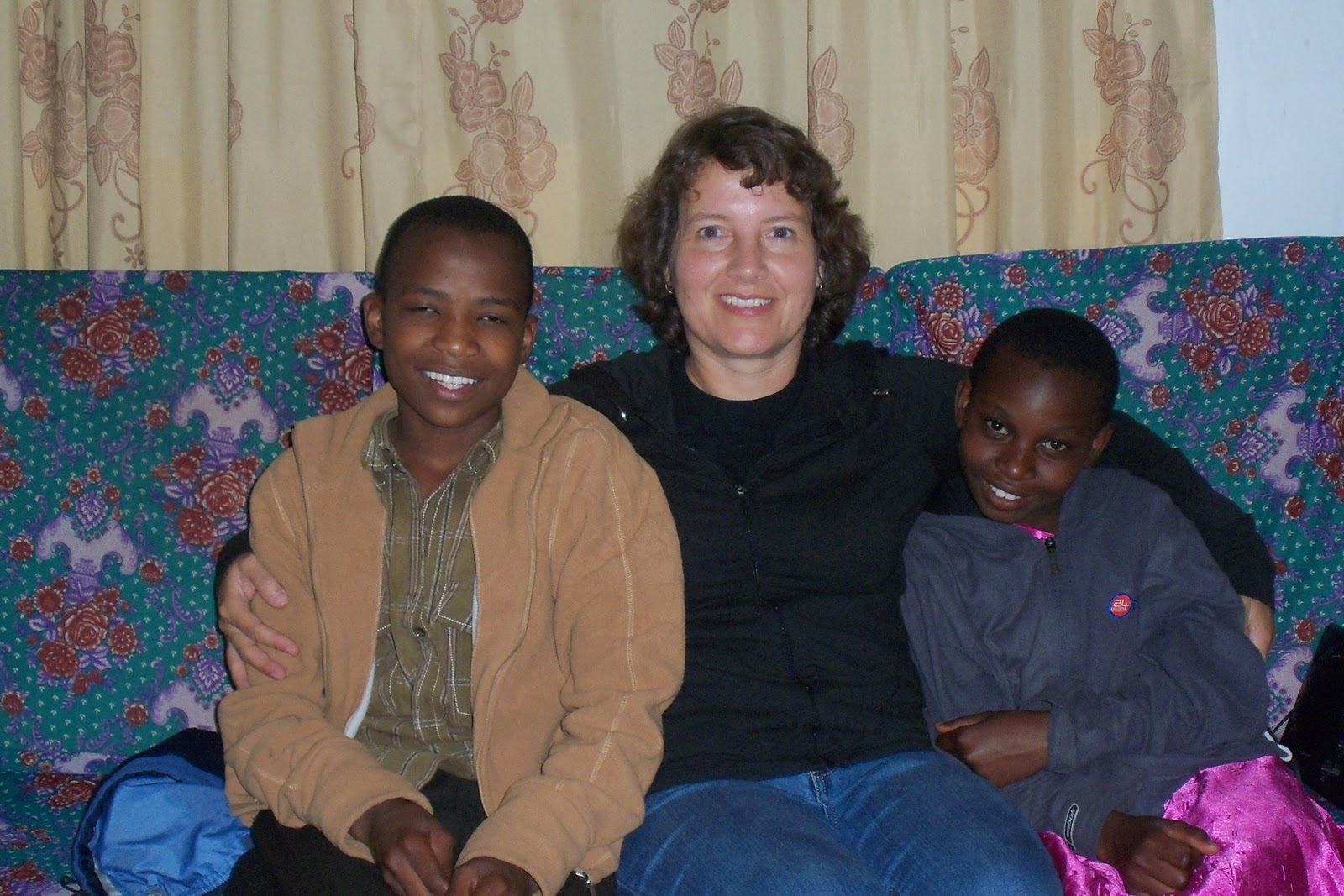
            I had the recent pleasure of spending an entire week with Neema and Maria at my home in Mkuu.  If this is what it is like to be a grandmother, I am really looking forward to it.  I had a lot of fun, especially with Maria.  I say it jokingly, but there really is something special about Maria.  She is six now and is completing her second year of pre-primary school.  Already I am seeing the benefits of enrolling her in a good, private English medium school.  I am sure she speaks English better than Yuda.
            One afternoon, Maria and I were out on the porch coloring pictures.  A man on a motorcycle drove up, stopped, and asked me something in rapid fire Kiswahili.  Maria looked up at him and said in a stern voice, “Speak English!”  The man looked quite flustered and said nothing.  I thought he probably did not know how to speak English, so I saved him from embarrassment and repeated what I thought he said in Kiswahili.  I was right; he wanted to sell me charcoal for cooking.  (Too bad I am leaving soon, because my understanding of Kiswahili is really improving). 
            There are many things that Maria loves: braiding my hair and sticking flowers behind my ears, eating, singing, dancing, drawing pictures, watching movies, and reading books, but the thing Maria loves best is to talk.  One evening when the power was out, we were all sitting together in the living room, so I suggested that we tell stories.  Maria eagerly volunteered to go first.  She told some complicated tale in Kiswahili.  Aggie translated into English.  Maria said she had another story, so we encouraged her to tell it.  I was amazed when she started telling a story in English!  OK, it was a very short story, but the child was speaking English!  Another day we boarded a very crowded bus to go to town.  Some kind old woman told Maria to sit on her lap so that she would not be crushed in the crowd.  I was standing nearby, and I could hear Maria jabbering away.  Several times I heard her say my name in conversation and I heard the bibis laugh.  I am sure that those women now know all of my business.  I was not so upset, but when we arrived in town, Agness gave Maria quite a lecture about talking to strangers.  A few days later, Maria was once again carrying on an animated conversation with a stranger, and the lady turned to me and said, “I am a primary school teacher, and this child will be going to A-level for sure!”
            Thanks to friends and family, I now have many movies on my computer.  Aggie loves to watch American movies, but Yuda often loses interest half-way through because he does not know the language and has not had enough life experience to understand what is going on through context.  When Maria and Neema asked to watch a movie, I was not sure if they would understand enough to enjoy an American movie, and I have no Tanzanian movies.  Anyway, I decided to show them Up, an animated movie about a little boy and an old man.  Aggie had once told me that I really know how to speak to children (she probably really meant that I speak Kiswahili like a child), but I thought I would try my skills at translating the plot.  It seemed mostly to be for Neema’s benefit, because Maria seemed to follow the story pretty well.  Over the course of the week, we also watched Finding Nemo, Madagascar, Over the Hedge, and a couple of episodes of Harry Potter.  Translating a cartoon may not be so difficult, but how do you explain events in Harry Potter?  Leave it to Maria; she shrieked with laughter at all the funny scenes (remember Dudley’s pig tail) and shouted “Ery Pota, Ery Pota, toka! Toka!” (Harry Potter, Harry Potter, get away from there!  Get away from there!) when Harry was in especially precarious situations.  Movies can be so educational.  Throughout the week she summarized the stories for whoever cared to listen, and I often heard her saying, “Mr. Fredrikson, I am so tired!” and singing, “I like to move it, move it.”  When I took the girls to a restaurant in Moshi, we saw some goldfish in a tank.  Maria called out, “Ruthi, Ruthi!  Look, it is Nemo!”  Luckily she did not insist that we help him escape.
            Adorable little Maria, so intelligent, so clever, so funny; she can always make me laugh.  All Maria’s stories make me wonder about her story.  How will it turn out?  I sense her insecurity at times, like the night I woke up to find an arm wrapped tightly around my neck.  As I tried to extricate myself, she latched onto me like a leach.  I held her for a bit and then felt a quick kiss on my cheek.  I kissed the top of her head and after a few minutes, I once again heard the sound of her rhythmic snoring.  I gently rolled her back onto her side of the bed.  In addition to her loving nature, she also has a very stubborn side.  She lives a difficult life, and I wonder which aspect of her personality will become the stronger one.  Will she grow up to have a compassionate heart helping out the needy, or will she become a mercenary soldier fighting only for herself?   She insists that she is coming to America to visit me one day, so maybe I will have the opportunity to find out. 
            God bless Maria, protect her spirit, and help her to grow strong in your love.


Friday, July 8, 2011

Saying Good-Bye

Saying Good-Bye
July 6, 2011
         
     I have always been an avid reader and have read many types of books; however my favorite have always been the ones in which goodness prevails over evil, problems find resolution, and stories have happy endings.  Maybe because of my optimistic outlook on life, I want to believe that this is reality, but I have lived long enough to know that life just does not unfold that way.  Often it seems that unfairness and injustice are the victors in most cases.  Problems may be resolved but are soon replaced by new ones.  Brief respites of happiness are inevitably followed by periods of pain.  

            My work here in Tanzania will soon be finished, and I desperately want to reassure you, as well as myself, that all of the people that I have written about will live happily ever after.  However, I cannot.  After all, this is real life and these are real people.  I cannot tell you how their stories will conclude.  My task was to plant the seeds; I was never meant to stay and watch them grow.   The rewards of the harvest are for God alone. 

            The sadness I feel at the thought of leaving those whom I have come to love is abated by my joy at the prospect of returning home to those I love equally as much, or even more.  Still, I struggle to say good-bye, because I know how difficult it will be for the ones I leave behind.  My heart especially aches for Yudathade and Neema.

            I remember the day when I first went to greet Yuda at his home far up the mountain.  He was a ragged looking, hungry little boy, living alone with no supervision and no love.  He was a child raising himself, facing all of his fears alone.  However, it was not his circumstances that were unusual.  There are many orphans in Tanzania living in similar or even worse conditions.  Rather, what is extraordinary is how dramatically this child’s life was changed.  I do not believe it was by luck or chance.  I believe it was by the hand of God.  It was a modern day miracle.

            In the time that I have known Yuda, I have always sensed that the thing that he needed most from me was a mother’s love.  The memory I will always cherish of Yuda is the one in which I opened the door one morning and saw him standing on my porch, a big smile on his face, joy in his eyes, happy to be “home” for the holidays.  This is what he needed; this is what he will lose when I go.  Yuda has lived without a mother for so many years that he does not even remember when she died.  I glimpsed the depth of his pain when we went to the local church office to obtain a copy of his baptismal card so that he could apply for a copy of his birth certificate.  The sister in charge may have been kindly, but sensitivity was not her strength.  As she filled in Yuda’s card, she looked at his name and said, “What kind of name is this?  Why would your parents name you Masumbuka (his tribal name)?  It is not a good name.  Do you use that name at school?  If you do, you will not have a good life.  Choose a different name.”  Yuda was speechless.  Aggie turned to me and said, “Madam, choose a new second name for Yuda.  Sister does not like the one his parents have given him.” While my mouth was still hanging open in surprise, Sister began throwing out some names: Amani (peace), Baraka (blessing).  Yes, that was the one: Baraka.  Yuda and I both liked it.  He had been blessed and he was a blessing.  Sister recorded his new name: Yudathade Baraka Liberathi Swai.

            Sister continued to talk.  Next, she asked Yuda about his parents, and he told her he really didn’t remember them.  She said, “What do you mean you don’t remember them.  How long have they been dead?  Who has been taking care of you?  What do you mean by no one?  Surely you cannot have been living alone, you are only a child. Maskini!  That is a terrible thing!” I looked over at Yuda and tears were streaming down his face.  I moved my chair closer so that I could put my arm around him. I wanted him to feel my love. I wanted him to know that I cared, even though I wondered how much comfort it would be, because soon I would be leaving him as well.

            Although I feel bad about leaving, I know that Yuda has hope now for his future, and hope is a powerful motivator.  Believing that his dreams are possible brings him closer to actually achieving them.  He goes to a good school, and his performance has improved remarkably in the year that he has been there.  He has food to eat every day.  He has books.  He has nice clothes.  He even has pocket money.  Aggie and Fidesta love him, and I have reassured him that we would continue to support him from America.  Yudathade, the rich little orphan boy: God has certainly blessed him.
            I cannot help but contrast his case with Neema’s.  Neema, whose name means “Grace of God,” is not an orphan.  She has a mother, a mother who would not or could not provide for her and never even sent her to school. Now Neema must do housework for a relative who beats her if she does the slightest thing wrong.  I wonder if she has ever been loved.  Neema and Maria recently came to visit me here in Mkuu.  I know it was only a brief respite, but Neema was able to rest from all her troubles for an entire week.  Aggie and I stuffed her with food and ripe avocadoes, hoping that she would gain a little weight.  Neema was in paradise.  Maybe for the first time in her short life, she was able to just be a child.  She laughed and joked, she sang songs and danced, she colored pictures and watched cartoons, but mostly she enjoyed the love.  Although she is almost 13, she held my hand whenever we went walking.  She sat close to me whenever she could.  She hugged me and prayed for me every night before we went to bed.  Neema does not speak English, so I decided to write her a letter in Kiswahili to remind her that God had not abandoned her.  I had a Native American “dream catcher” key chain that one of you sent me in a package, so I decided to give it to her.  If she hides it well, maybe it will give her courage and strength when life seems especially difficult and dark.  I explained the legend of the dream catcher in the letter.  Neema is not a good reader (remember she just started school about a year ago), so I asked her if she wanted me to read it to her.  She eagerly said “Yes!”  As I read her the letter, I felt her begin to shake. I glanced over at her and saw that she was silently sobbing.  I finished the letter and then we just sat for the longest time, me holding her in my arms and kissing the top of her head.  I could feel her pain radiating out of her.  I wished that I could absorb it all, but it was not possible.  Her well of sorrow is very deep.

            In order to catch the bus back to Morogoro early in the morning, it was necessary for the girls and I to spend a night in Moshi.  That experience was another treat.  While doing a bit of shopping, I noticed a store with a sign saying: We will test your eyes for a good price.  I had suspected that Neema needed glasses, so on a whim, I took her in to be tested.  I was right.  We ordered her glasses (less than $20 USD) and were told to come back in 2 hours.  We went to a restaurant and indulged in chipsi kuku (fried chicken and fries), picked up the glasses, and then returned to the hotel to watch TV.  Maria also took 2 or 3 warm water showers, something she had never done before.  The next morning I escorted them to the bus stand, carrying their big bag on my head. (It really is easier than trying to carry a heavy load with your arms).  As we waited for the bus, Neema asked me if I would be coming to Morogoro again before I return to America.  I told her probably not.  Then she began to cry.  I held her close and told her I loved her, but inside my tears were flowing for her too. 

           You see, while Yuda has hope, Neema has none.  She struggles to learn in a poor government school.  To others it may not seem like much of an accomplishment, but last year she was number 47 out of 49 students.  This year she is number 30 out of 35.  Yuda most likely will pass his exams and go on to A-level studies.  The chance of Neema passing her primary school exams and being selected for secondary school studies is very slim.  Hopefully she will at least learn to read and write.  How she will support herself in the future, I have no clue.  While Yuda has no parents, he at least has Aggie and Fidesta to love him and take care of him.  Neema has no one.  At the end of the school day, she goes home to cook and clean for people who mistreat her.  She has no time to study.  Aggie and I have talked about trying to find her a private boarding school, but it would have to be a very special school with loving, caring teachers.  She is almost 13 and only in the 4th grade.  She needs a lot of individual help and attention.  I wonder where I would find that in Tanzania, and if I could, would her family let her go?  I so want her story to have a happy ending, but I am afraid it will not.  Only God can move her mountain and if he does, it will truly be a miracle.

Saturday, June 18, 2011

Moving Mountains


 Moving Mountains
June 19, 2011


In memory of my father, “Happy Father’s Day”
Dedicated to my mother, “Happy Birthday Mom”

Down in the flatlands surrounding Moshi, I have noticed some unusual free-standing hills.  What makes them odd is that some of them have been nearly carved in half, most likely by human hands.  Every time I see them, I wonder, “How does one move a mountain: bucket by bucket or one stone at a time, and if you were to try to move a mountain, how long would it take?” 

Traveling across the Same desert last week, I was surprised to see that the usual barren landscape had turned green.  But what struck me most were the flowers adorning many of the scrubby bushes, vibrant splashes of color amidst the otherwise bleak terrain.

It was a long bus ride to Morogoro and I had nothing to do but think, so I contemplated moving mountains and thought about recent splashes of color in my life.

  Protas, a young man who prepares the food for the priests, the sisters, and the girls who live at the church hostel, came to my house one day to ask if I would teach him English.  I was not certain that I would be able to help him much, but I said ok.  With a big smile on his face, he thanked me profusely, “Thank you Madam, thank you madam. I will come on Sunday.”  Then he bowed and ran away.  The next Sunday afternoon, he was at my door dressed in his best clothes and with a brand new exercise book in hand.  We started with simple greetings, and although he was thrilled with everything we did, what captivated him most was learning prayers. He wanted to pray the Rosary in English.  Fortunately, even though I am not Catholic, I spent many years helping my own children learn these same prayers.  So together we recited the “Glory Be,” “Our Father,” “Hail Mary,” and the “Apostles’ Creed,” in Swahili and in English.  Aggie was there to help us.  One Sunday, as Protas was preparing to leave, Aggie told him that I would soon be returning to America forever.  His face fell and he said, “No Madam! Please stay!”  I told him that I had to go and then he said, “Then take me with you.”  “Protas, I cannot take you to America.” “But why Madam, is it because of my English?” “No Protas, it is because you do not have a passport.” He laughed at that but I noticed as he walked away, that the usual spring in his step was missing.  Aggie told me afterward that Protas had never been to school and that learning English was making him very happy.  I was shocked!  What I was thinking was ordinary was really extraordinary.  Here was my splash of color in the desert.  Protas had never been to school, yet he could read and write.  Protas had only one afternoon free every week and he was using it to learn the Lord’s Prayer in English.  The small amount of time that I was sacrificing was nothing in comparison to what it had given him: dignity and a sense of self-worth.  With God’s help, Protas had moved his mountain; he had added color to his own dreary life. 

Here at Mkuu, we have one teacher who is in charge of preparing and conducting “practicals” (science labs) with students.  The other day, I went in to observe my form 6 students perform a qualitative analysis practical.  While they were busily engaged in many chemical tests, I talked to Mr. Ludovick, the young teacher in charge.  I gave him another lab manual that I had acquired at some Peace Corps training.  He showed me a pair of rubber safety goggles that he had purchased for himself after reading a manual I had given him about lab safety.  I praised him for his good decision.  Then he said, “Madam, I see you are not like other teachers.  You are so different.  Your students love you.  Madam you have really helped us very much.  Please extend your contract.  Stay for another year.”  I have not really felt like I have made a big impact here at Mkuu, especially among the teachers, so it was nice to hear him say that maybe I have made a difference.  I said to him, “I am sorry.  I like it here but it is time for me to go.  I must go home, but Mr. Ludovick, I have noticed that you are different too.  You do not just come to school to eat lunch and make stories. I have never seen you yell or hit a student with a stick.  You work very hard, and you have done a great job preparing these practicals.  You care about your work and the students see it.  I know that being a teacher is not easy here in Tanzania, however I believe that you can help to change that.  Continue being a good role model for the others and maybe some will follow.”  As he replied, I once again sensed color being splashed across a barren bush. He said,“Thank you Madam, but I have only been copying you. You inspire me.  I will really miss you when you go.  Your students and I, you will hear us crying from the plane.” Again I was amazed by the realization that Mr. Ludovick was also moving a mountain, because he had decided to be different from the rest.  Both he and Protas were embracing change because they wanted more from life.

Small splashes of color, little glimmers of light, unexpected acts of kindness, and lots of love; that is what is needed to move a mountain. 

Moving Mountains

How does one move a mountain?
Bucket by bucket or one stone at a time?
How does one move a mountain?
And if you try, how long will it take?
Maybe as long as your dream.

I struggled to move my mountain
By shouldering the load alone.
I struggled to move my mountain
Believing that God could not be found.
 But when the burden became too heavy
And I fell to my knees in defeat,
It was there in the quiet I sensed it,

Within me, around me:
A presence, a force, a peace
Incomprehensible power

And then
My mountain moved.

Sunday, May 22, 2011

Counseling

Counseling
May 21, 2011


Early this month we had a baraza: a whole school assembly.  The purpose of the meeting was to welcome the new students, introduce the teachers and other staff members, review all of the school rules and procedures, and then address student concerns.  Madam Massao was to speak about counseling services and invite students to come to our office.  Unfortunately, she was ill on the day of the baraza, so the task became mine.  I am fairly proficient in writing Kiswahili, so I quickly wrote a short speech, and when the time came, I delivered it.  I was a hit!  Students clapped and cheered.  Teachers congratulated me on my superb Kiswahili; I pronounced every syllable so clearly and correctly.   Maybe they were humoring me, but the students must have understood my message, because soon they began to come to the office, and I quickly realized how under qualified I was to be a counselor.

The first to come was one of my own students.  He is a quiet student and works hard, but he has missed many days due to illness.  He was returning home the next day to receive more treatment.  As he told his story, he began to tremble and I could see that he was struggling to hold back tears.  I was not as successful, because mine were freely flowing.  What do you say to a young person who tells you he has lost his hope?  There was no one else to refer him to, Madam Massao was still sick.  I was all he had at the moment so I prayed that I would say the right thing.  I tried to reassure him that there was always hope, always opportunity, no matter how difficult life might seem at the moment.  Then I suggested he repeat form 5.  His family is poor and he was concerned that they would not be able to pay school fees for an extra year.  I told him to talk to them.  He was also very discouraged about his illness.  The treatment he was receiving at the local hospital did not seem to be working and it was very difficult to study.  His doctor would not give him permission to seek treatment at a better hospital.  I told him to talk to the doctor again.  Although he did not think it would make a difference, he agreed to try.

The next week he returned with a smile on his face.  His parents agreed that it was best for him to repeat form 5 and would pay the school fees.  The headmaster approved the shift.  His doctor had given him permission to go to a hospital in Moshi for more tests.  I gave him his first test as a new form 5 student and he scored an A, the second highest grade in the class (out of 62 students). Hope, it is such a powerful thing.


My second case was even more difficult, mostly because it is so common here, especially among the girls.  This student was an o-level student so her English was not so good, but we managed to understand one another.  She had been living with her grandmother, but her grandmother chased her away because she had parents who should be supporting her.  The child went to her parents’ home but soon encountered problems with her father.  He was a drunkard and refused to pay her school fees.  He told her to go to town and earn some money.  (she is probably 14 or 15 years old).  She went to Moshi and found a job washing clothes and doing some cleaning.  When she had earned enough money, she returned to school.  However, the father did not approve of her studying and told her to leave his home.  He said he would kill her if he saw her there again.  She did not know what to do nor did I have any good solution to offer her.  I wanted to call social services or a child protective agency, but there are none, so I asked if there was another family member she might stay with or who might help her.  She said there was an aunt who might pay her school fees but only if she lived with the grandmother.  I suggested that she return to her grandmother.  She said her grandmother would not allow it. I asked her if there was a church member or neighbor she could talk to, but she said her parents did not allow her to go to church.  I was stymied.  Feeling totally ineffective and useless, I said some encouraging words and told her I would talk to Madam Massao when she returned.  When Madam returned, she called the student in and spoke to her again.  She told her to speak to the headmaster.  Sometimes students are allowed to come to school and take their exams even though they have not paid their school fees.  However, they do not receive their certificate until their debt has been paid.  As far as her home situation was concerned, if she must remain with her parents, then she should do what it takes to survive: keep quiet and stay out of her father’s way, especially when he has been drinking.  My heart is too soft to be a counselor.

Nothing in Tanzania is simple, no task is easy, even sending your child to school.  I sent Fidesta to Bigwa Sisters, a private Catholic girls’ school hoping that she would be safe there and she would have books, and resources, and teachers who cared.  What a joke!  One evening I received a covert call from Fidesta.  She said all of the students were leaving and Sister would soon be calling me, but do not let her lie to me.  I was to demand that she return all of our school fees.  The next day Sister called and said there was a problem at the school.  The science teachers had not come and the girls would not be patient (they had already been there studying with no teachers for at least 6 weeks. Impatient?)  They had all decided to leave Bigwa and go to other schools. Fidesta would be returning home.  I pretended that it was all news to me and made arrangements for Sister to return our money to my account.  I went to speak to my headmaster to see if it would still be possible for Fidesta to go to Longido, the government school to which she had been selected.  He knew the headmaster there so he called him to ask.  Fortunately, it was still possible, (six weeks late, but still possible).  Fidesta came home, we filled out the required papers, found enough money and sent her off to Longido alone.  I had bought her a good phone, but she did not want to get caught with it and expelled, so she left it with me.  I was a bit uneasy because I had no way of knowing if she had arrived safely, but eventually she borrowed someone’s phone and sent me a message.  She said Longido is a nice school but her teachers no.  I am not sure what that means; she has no teachers at Longido or the teachers are not good?   What do you have to do to get a good education here?  Our children in America are so lucky and they do not even know it.

 On a lighter note, one weekend at mass Padre said that if any of us were living together as man and wife without benefit of marriage, then we were living in sin, and we were to come to church the next Saturday to be married.  Aggie told me that 103 people came the next weekend to be married.  (103 people, I thought that was rather funny)

I now have many lizards who share my living quarters with me, small ones, not so small ones, pink ones, brown ones, even ones who talk.  Yes, it is true.  I do not know his language, but while I am sitting on my bed studying or reading in the evening, there is one who clings to the wall near me and chatters and clicks.  I do not mind the lizards because they eat other bugs, but if only I could litter box train them.  They also encourage me to use my mosquito net every night, because even though I think they are sort of cute, I do not want any of them running over top of me while I sleep.


Thursday, April 28, 2011

Final Chapters

 The Final Chapters
 April 28, 2011


I know I have not written in a while, but it has not been because I have nothing to say, but rather, it is because I have too much.   Sometimes it seems as if my feelings are too big for words.  I know that my work here is nearly finished; the story is nearly told.  Soon I will move on.  A new road will appear and I will follow it.  A traveler always does.

There are so many lessons I have learned, so many things I will miss (or not).  Where in America will I have the opportunity to literally embrace my neighbors on a public bus, maybe even popping my shoulders to try to fit in? Where will I buy stiff porridge if I have a late night craving for a large lump?   I dream about America: going to a mall, eating pizza, driving a car, taking a hot shower, having electricity and water every day.  Yet, as I sit on my porch, I realize that in some way, I will miss this life, but especially, I will miss those I have come to love. 

Yudathade was here for the Easter weekend.  He was “hodiing” at the door early Friday morning with a big smile on his face.  He must have left school at dawn, excited at the thought of going home.  I may not think my house here is much compared to what I lived in in America, but for him it is a mansion.  For the first time in his life he is living in a house with indoor plumbing, electricity, and cement floors.  He does not have to worry about people breaking in at night to harm him or his sister.  He has someone to come home to, someone who cares.  After exchanging greetings, he proudly showed me his mid-term exams.  His grades have improved significantly in most subjects, especially physics.  Now it is his favorite class.  I hugged him and told him how proud I am of him.  In the short time that I have known Yuda, I have always sensed that this is what he was longing for.  Love was what was missing from his life.  Is this why God sent me?  To remind him of a mother’s love.

Fidesta is now in Morogoro, studying at Bigwa Sisters, an all-girls Catholic high school.  I like the place.  I like the head sister.  I think Fidesta will be safe there, although like everything in Tanzania, there were challenges to overcome in getting her there.  She applied to study PCB (physics, chemistry, and biology combination) and despite her mediocre form 4 results, Sister gave her permission to come.  Fidesta’s generous sponsors in the US paid her school fees, and then she and I went to Moshi to shop for all the other things she would need.  I bought her books for each subject, a rarity for most Tanzanian students.  On the way home Fidesta told me that she felt like President Kikwete’s child, more than rich, because she had everything she needed.  She had never known a student who had as many books as she had.  She promised she would study very hard.

Finally the big day arrived.  I had been at a Peace Corps meeting earlier that week, so I met Aggie and Fidesta in Moshi.  We stayed at a relative’s house for the night, and then escorted Fidesta to the bus in the morning.  As we stood together on the sidewalk waiting for the bus to arrive, I put my arm around Fidesta and told her that I loved her very much.  I was surprised when she turned and walked away. Then I saw her standing alone behind a tree sobbing.  Fidesta had already lost one mother; she did not want to lose another.   Again, I was a bit startled to realize how much I really meant to her.  Love is a powerful thing.  I reassured her that I would always love her no matter where I happened to be and that “if God wishes” (a common Tanzanian expression) I would return to see her one day.  “Really Madam?  Oh please come for my graduation.”  I promised I would try.

The bus arrived and the conductor struggled to lift her trunk into the boot.  He asked if she was taking rocks.  She laughed and said, “No, just books.”  Then she boarded and the bus pulled away.  Fidesta was gone.  Now I struggled to control my own tears.

I was expecting Fidesta to call when she arrived at school; however, I was not prepared for what she had to say.  There were not enough students to offer both PCB and CBG (chemistry, biology, and geography) so Sister had chosen CBG.  Fidesta wanted me to make the decision as to what she should do.  I told her I was here to give her opportunity not to direct her life.  She must decide.  She told me that she wanted to study PCB and maybe she could shift to Longido, the government school to which she had been selected.  Silently I was saying, “Oh please, not a government school” while at the same time I was saying out loud, “Ok Fidesta, if that is what you wish.”  I spoke with Sister and made arrangements for Fidesta to return home so that she could enroll at Longido as soon as possible.  I was disappointed but willing to accept the switch if that is what Fidesta truly wanted.  Therefore I was surprised when Fidesta called me again later that night.  Apparently Sister had counseled her and convinced her that it would be better for her to remain at Bigwa and study CBG where she knew she would have teachers and resources, rather than risk studying PCB at a government school where there would most likely not be enough teachers and very few resources.  Physics is difficult enough, without having to learn it on your own.  All these things are very true.  Thank you God for Sister!  (I talked to Fidesta on Easter Sunday and she is very happy that she remained at Bigwa).

Agness continues to study diligently for her qualifying exam in the fall.  If she passes, she will be allowed to study for her form 4 exams.  Receiving an O-level certificate is what she wants most right now.  Agness has made many mistakes in life, and she worries that I will not love her if I know the truth.  However, she does not know that I already know much about her past, and it does not matter.  I have seen her heart and it is good.  I have always felt like I was supposed to do something for Aggie, but I never was sure what it was or why it should be done. Once again, I think that the answer is simply love and opportunity. She made me a Valentine’s Day card this year, and in it she wrote, “I never really knew love until you showed me.  Thank you Madam.  I love you very much.”   Maybe this opportunity has been God’s invitation to Aggie, “Come and live a better life.”  May God continue to help her see the way.

My own life has not been uneventful.  There was another moment recently where I almost called it quits.  I have been working very hard lately, and maybe like Fidesta says, I have not been eating enough ugali (stiff porridge).  I have not been feeling so strong, so I called the Peace Corps doctor.  He told me to come to the office for some tests.  I agreed to come after Easter.  So the Wednesday before Easter, I made a quick trip to Moshi to get money to buy a bus ticket to travel to Dar. When I boarded the bus to return home to Mkuu, there was a seat behind the driver that seemed to be free.  I asked a lady nearby if it was available and she said “yes, it is free.” So I sat down to wait for the bus to depart.  However, soon another woman came on the bus yelling that I had taken her seat.  She seemed a bit crazy, so I said “hamna shida,” and I moved to the other side of the aisle.  She put her stuff down and got off the bus.  A short time later, she boarded the bus again, yelling and screaming and hitting a young man with her purse.  She shouted “Mwizi! Mwizi!”  (Thief! Thief!).  All of a sudden, a crowd of men jumped on the bus and began beating the young man.  The bus was rocking back and forth.  Luckily, I was in the front and somewhat sheltered from the crowd.  But I watched as they tore off his shirt and dragged him off the bus by his leg.  They dumped him on the ground right below my window, and I watched in horror and disbelief as they kicked him and stamped on him.  He was about the same age as my A-level students, but his clothes said that he was very poor.  I did not know if he had tried to steal from this woman, but I knew this was not right.  These people were going to kill this boy.  I did not know what to do, my hands were shaking and tears fell spontaneously from my eyes.  I felt powerless to control the frenzy but I said “Acha! Huruma! Huruma!” (Stop! Mercy! Mercy!), then I prayed.  Soon some big men came running up and placed themselves between the boy and the crowd.  When they had calmed the crowd enough, they picked up the victim and carried him away.  The young woman next to me said softly, “Mzungu, mzungu, don’t cry.”  How ironic that her concern was for me.  Finally the bus departed and I was left to my thoughts.  On the way home I was thinking how uncivilized this country is, but I knew that that was not really true.  These were not the actions only of Tanzanians.  These were the actions of mankind.  Mob justice, out of control fervor for a cause, it has occurred over and over throughout the history of man.  What I had witnessed must have been very much like what occurred during the crucifixion of Christ.  I had always wondered how good people could behave so cruelly and without regard for human life.  Now I know.  I have seen.

I do have some happy news to report.  I have been doing a series of teacher workshops at my school and the theme is “Change Begins with You.”  We have talked about how teachers are leaders and about the power they have to really make a difference in a student’s life.  Already I have seen some positive results.  I have seen more teachers actually entering their classes, and when they do, they seem to be teaching with more energy.  Recently, a student came to her teacher to tell her about some difficulties she was having at home.  Her family was very poor and she had no money to buy exercise books and pens.  She was thinking of leaving school.  Instead of telling her to get out or hitting her with a stick, the teacher counseled her and told her to fight for her own life, no matter what was happening at home.  Then she took her to the school shop and bought her the things that she needed.  The second master also told me that one young teacher, maybe not always so hard-working and respectable in the past, had volunteered to help teach A-level General Studies for no extra pay. Extra work for no pay; that is indeed a miracle!

 
Opportunity, love, respect, encouragement: that has been my mission here.  I know it will not change the world, but maybe it will change life for a few.

Saturday, March 19, 2011

Uninvited House Guests

Uninvited Guests
March 19, 2011

Part of the Peace Corps philosophy is that we live like the people in our communities, and I have done my best to blend in.  Recently I discovered that I share an experience that almost every Tanzanian has experienced at least once in their lives: uninvited houseguests, minyoo (worms).  I will spare you all the graphic details, but I was not happy.  I looked in my Peace Corps health book.  Nothing, although it did say that under no circumstances was a volunteer to seek medical care at a facility in their community without permission from the Peace Corps medical officer.  To do so would be grounds for separation.  Ok, sounds serious, so I called my PCMO and he told me to go to the hospital in my village.  My village! I have seen that hospital.  That is where the slow (only kind we have) internet is located.  He wants me to go there?  I went and what a treat it was, because it gave me a rare peak into the world of medical care in a small village in a developing country.

First thing I had to do was open a file.  The man taking down my information on a small scrap of card board asked me the expected questions.  Then he wanted to know the name of my tribe.  I told him that I do not have a tribe.  So he told me to write the name of my tribe in America.  Again, I told him that we do not have tribes in America.  He let it go, but when he returned with my pink hospital pass, I glanced at it and there next to tribe it said “Chaga.”  I always tell people here that I am Mchaga Marekani.  It is true, we are a mixed tribe and do not all speak the same tribal language.  That is why my kichaga (language) is different than theirs.  I also have been given many Chaga names, mostly by old men coming out of the bar late in the afternoon or by crazy people walking along the road or by my girls.  My name is Teresia Mamasawe Makaishe Angel Malaika.  Anyway, now it is official.  It says right there on my card: Chaga.

Back to my story.  The hospital was crowded but I got special attention.  One of the doctors personally took charge of my case (I think he is a doctor).  He moved me from the file desk to the payment desk (the file cost about $1.50) then to an office for consultation and exam.  He went out a few times to borrow the doctor equipment: stethoscope, blood pressure cuff, thermometer.  You see the point.  He told me that I would need to be tested so he escorted me to the lab.  The woman handed me a small glass bottle with an opening of about 1 cm and a plastic vial with a small spoon attached to the lid.  Many of you know me, give me a paper and pencil test, no problem, but this was just too much for me.  I tried to ask the doctor and the lab assistant how it would be possible to collect a sample in that small jar.  The doctor thought that I did not know what it was for, so he explained the whole procedure.  Then he said, “Now where do you think you should go to collect the samples?” I was thinking that maybe this was part of the test, but then I remembered that Cheryl had used the hospital restroom before and had described it to me.  No I did not want to go there.  He asked again, and I was going to suggest outside behind a tree, when I remembered that the Lutheran hostel has a decent restroom.  I told him I would go there and then return.  Luckily they had soap in the bathroom that day because I used a lot of it.  Went back to the hospital, turned in my samples to the lab station, and sat down to wait.  Then the power went out.  The lab tech opened her window and told me that the power was out.  I said “I know,” and she said, “Ok, wait.”  After an hour or so, the doctor came and told me that the power was out, what should he do?  I thought that maybe calling Tanesco and telling them to turn it back on might be a good idea, but kept that to myself.  I said that I would return the next morning.  He said “good, that is what we should do,” and he gave me another jar and vial.  Wait one minute, I worked hard for that first test.  Now I have to take a retest?  “Yes, the first one would be destroyed.”  Ok, anything to get rid of those uninvited guests.  All they do is grumble and complain and eat my food!  I went home and gave the test another try the next morning.  However, I know that my first results were better.  I returned to the hospital and the power was on.  The lab tech ran the tests.  Nothing.  The doctor took me back to the office and then ran out and returned with some books.  He said that often tests can be negative but he takes worm pills every three months just to be safe.  Based on my descriptions, he felt sure he knew what it was, so he opened the books to show me different medicines available.  Then he said, “Which one would you like?”  Again, I was confused, feeling like I was in a different world or something.  He insisted that I look at all the choices.  I was kind of partial to the one whose side effects said nausea and diarrhea, but I like to blend in, so I chose the one that said “most commonly recommended.”  We went to the dispensary and my pill was dispensed.  It cost less than 10 cents.

I chewed it early in the morning on an empty stomach and waited all day.  The free loaders were sure taking their time packing their bags.  Probably stealing the silver ware and whatever else they could find.  Finally, the second day, peace and quiet!

PS If any of you were considering this as a weight loss plan, I do not recommend it. It stinks!

People


People
March 18, 2011

            I have been a people watcher for most of my life and have always assumed that I am a pretty good judge of character.  Recently, I have come to realize that my first impressions of many people here may only have been characters that I created in my head.  I viewed Tanzanian people through American eyes.  It was all I knew.  I matched behaviors that I saw to personalities I knew back home.  I judged them according to my standards.  It was my way of making sense of a new and strange environment.  However, my eyes have changed.  They are no longer solely American.  Is it possible that a part of me has become Tanzanian?  Now I often find myself reassessing my opinions of the people I have met.  Culture really makes a difference.  It reminds me of a kaleidoscope.  In one frame you see a certain image, but give it a twist, overlay it with a different culture and the picture changes.  People that I wrote off as lacking in morals or common sense have become good people, but conversely, people that I ascribed with good intentions and kind hearts now seem to have been only serving themselves.  At first this was very troubling for me.  How could I have been so wrong about a person?  How could I have made such a mistake?

            I imagined throwing the kaleidoscope down and the cover coming off, spilling hundreds of tiny, individual crystals out on the floor.  Each one was different, but then again, they all were alike.  Arrange them one way and you see an American, another way, and they have become Tanzanian.  I am beginning to understand.  Strip away the culture and you see the heart.  You see the person.  I have begun to trust my eyes less and rely more on what I feel.  Unfortunately, what I feel most is pain.  For some, like Neema, it is very strong.  It is true, she goes to school now.  She is learning to read and write, but when she leaves the school, her coach becomes a pumpkin again.  She returns to the world she has always known.  She is my house girl without a name.  She lives in fear of making a mistake but in everything she does, she will err.  She does not speak because she will always say the wrong thing.  She does not laugh because the joy has been beaten out of her long ago.  This is the life she knows.  Neema means “grace of God.”  My friends Kris and Keli sent her an angel ornament for Christmas, a white angel carrying a lamb.  I gave it to her when I visited in February.  She smiled and said, “For me?”  Yes, Neema, you are the lamb.  God has sent you a white angel to remind you that you are a very good girl and that you are truly loved.  Let your soul rest in God’s arms for a while.  I said a prayer that she would be allowed to keep the angel.  I prayed that she would always keep the memory. Oh, sad little Neema.

            Who is her tormentor?  Who would beat this slight child with a stick?  My friend, Victoria, that is who.  You are probably thinking, “How horrible,” but if you were Tanzanian, it is very likely that you would do the same. I have stopped separating people here into categories of good and bad based on whether they hit children with sticks.  Now I judge them on how much or how hard they like to hit.  Remove the culture and observe what is there: pain, discouragement, hopelessness, frustration, fear.  We would all like to say that we would do better than this, but faced with the same circumstance, who knows how we would respond.

            There are others whose lives have been so difficult that you would not blame them if they have become cynical and cold-hearted.  You want to congratulate them for having managed to survive.  But when you get to know them you are amazed at the beauty and strength of their spirit.  They have not just survived, they have thrived.  God has protected them for some purpose, like Fidesta.

            “Tell me a story Fidesta, a happy story about your childhood.”
            “A happy story Madam?  I do not remember any.”
            “You have no happy memories? Then tell me about your life.”  

And she told her tale of four young children, all in primary school, living alone as a family.  Fidesta was in 3rd grade and Yuda had just begun school.  As the years went by, the family became smaller and smaller.  The oldest brother left to study at an A-level school in Dar.  The older sister decided to marry in order to escape.  Fidesta and Yuda were alone.  Life was very difficult.  They had to rush from school in the afternoon, prepare food, and do their chores to make sure they were inside and the house closed up before dark.  That was when the nighttime visitors began to arrive, men banging on the walls of the house, calling Fidesta to come out.  She and Yuda had a battery powered radio and they turned it up as loud as it would go to block out the voices.  Still they were afraid and could not sleep.  Fidesta could not study.  She developed peptic ulcers and could no longer eat beans.  Someone at school told her to shift to Mkuu; they had a hostel for girls. She received permission; however, now Yuda, was left alone.  Safe from the men but not from the stress, Fidesta worried constantly about her young brother.  Sometimes she would make up stories to leave campus and would sneak home to see how he was faring.  She really did not have much hope for her future.  Survival was her life.

            “Madam, I have remembered a happy story!  Two stories in fact!”
            “Tell me Fidesta.”

The first happy story took place after Fidesta had been sick and had stayed overnight in the hospital.  She needed 15000 shilings to pay her bill.  She had no money so she went to her grandfather and asked him to help.  He told her he had no money to give to her, and when she pleaded with him, he told her to go ask her dead parents.  Maybe they would reach up from their graves and give her some.  She did not know what to do, so she went to her parents’ gravesite and cried.  Feeling defeated, she returned to school.  A few days later, Sister called for her and told her she had visitors.  She could not imagine who it could be.  She went to greet them and met a couple who had been friends of her parents.  They wanted to give her some money, 50000 shilings.  Fidesta was astonished. She thanked them and they went away.  She made up a story and went home.  She paid her bill and then gave Yuda his half of the money.  He was afraid.  He demanded to know where she had gotten such a sum.  She told him, “From God.”

The second happy story occurred fairly recently.  Fidesta needed a place to stay for the school break because the hostel was closing.  She had no idea where to go.  She was sitting on a wall near the church when she saw a “Mzungu” come out.  Her friend told her to go ask the white teacher.  Maybe she would help.  Fidesta was afraid.  She said, no, she could not, but God gave her courage and put words in her mouth.  She went and asked the woman if she could carry her bag and escort her to her home.  You know the ending of that story.  God brought them together.  Now Fidesta has a mother, she and her brother go to good schools, she has hope and a future.  God has blessed her indeed.  That is a happy story.  But the thing that touches my heart the most is that Fidesta has promised God that when she gets a job, she will find two young orphans, a little boy and a girl, and she will give them a new life like God has given her.  Every day, I am amazed at her loving heart and her profound faith.  Fidesta, what a beautiful spirit!